
How to Find Suffolk County Arrest Records
An arrest in Suffolk County leaves more than one trail. The arresting agency creates an arrest report and a booking record. Once a case is filed, the court creates a docket. To find a recent arrest, the fastest public clue is often the court arraignment, not a jail roster, because Suffolk does not publish a full live booking list online.
Start with the question of where the case landed. A Boston arrest usually moves to Boston Municipal Court for arraignment. A Chelsea or Revere arrest may route to Chelsea District Court. A serious felony can be indicted later in Superior Court. Use these steps to trace an arrest.
- Identify the arresting agency and the city of the arrest.
- Search the likely court on MassCourts for an arraignment or complaint.
- Check custody status through VINELink or by calling the Sheriff.
- Request the arrest or incident report from the police department that made the arrest.
- For full criminal history, request a CORI report through the state.
For the broader case history after arraignment, see Suffolk County court records.
Who Makes Arrests in Suffolk County
Several agencies create arrest records across the county. Boston Police make the most arrests, but they are not the only agency. MBTA Transit Police, Massachusetts State Police, and the local departments in Chelsea, Revere, and Winthrop all book people. Each agency keeps its own arrest reports.
That matters for a records request. An arrest report comes from the agency that made the arrest, not from the court and not from the Sheriff. The Suffolk County District Attorney then prosecutes the state case, while the Sheriff handles county custody after a court commitment. Federal arrests follow a separate track through federal agencies and courts.
Arrest Record vs. Criminal Court Record
An arrest record and a criminal court record are related but not the same. The arrest record is a police product made at booking. The court record begins when a case is filed or arraigned. The comparison below shows how they differ.
| Feature | Arrest Record | Criminal Court Record |
|---|---|---|
| Created by | Arresting police agency | Trial Court clerk |
| When | At arrest and booking | At filing or arraignment |
| Shows | Charge alleged, booking data | Docket, pleas, disposition |
| Where to get it | Police department | MassCourts and the clerk |
An arrest does not prove guilt. Many arrests end in dismissal, a not-guilty finding, or no charge at all. For the full case outcome, the court docket controls, not the arrest report.
Charges vs. Convictions in Suffolk County
People often read an arrest record as a record of guilt. It is not. A charge is an accusation. A conviction is a finding of guilt by plea or verdict. The two carry very different legal weight, and a Suffolk County criminal record can show charges that never became convictions.
| Point | Charge | Conviction |
|---|---|---|
| Meaning | An accusation only | A finding of guilt |
| Proof of guilt | No | Yes |
| Possible outcome | Dismissal, not guilty, CWOF | Sentence or probation |
| Record effect | May be sealed if non-conviction | Sealed only after waiting period |
A Massachusetts disposition called CWOF, continued without a finding, is not a conviction but can still carry record consequences. Read the full docket before treating any entry as a conviction.
CORI: Suffolk County Criminal History
CORI stands for Criminal Offender Record Information. It is the regulated criminal-history product controlled by Massachusetts law, and it is different from a public court docket. Not every criminal-history item is public the same way a docket is. Who may get CORI, and for what purpose, is set by statute.
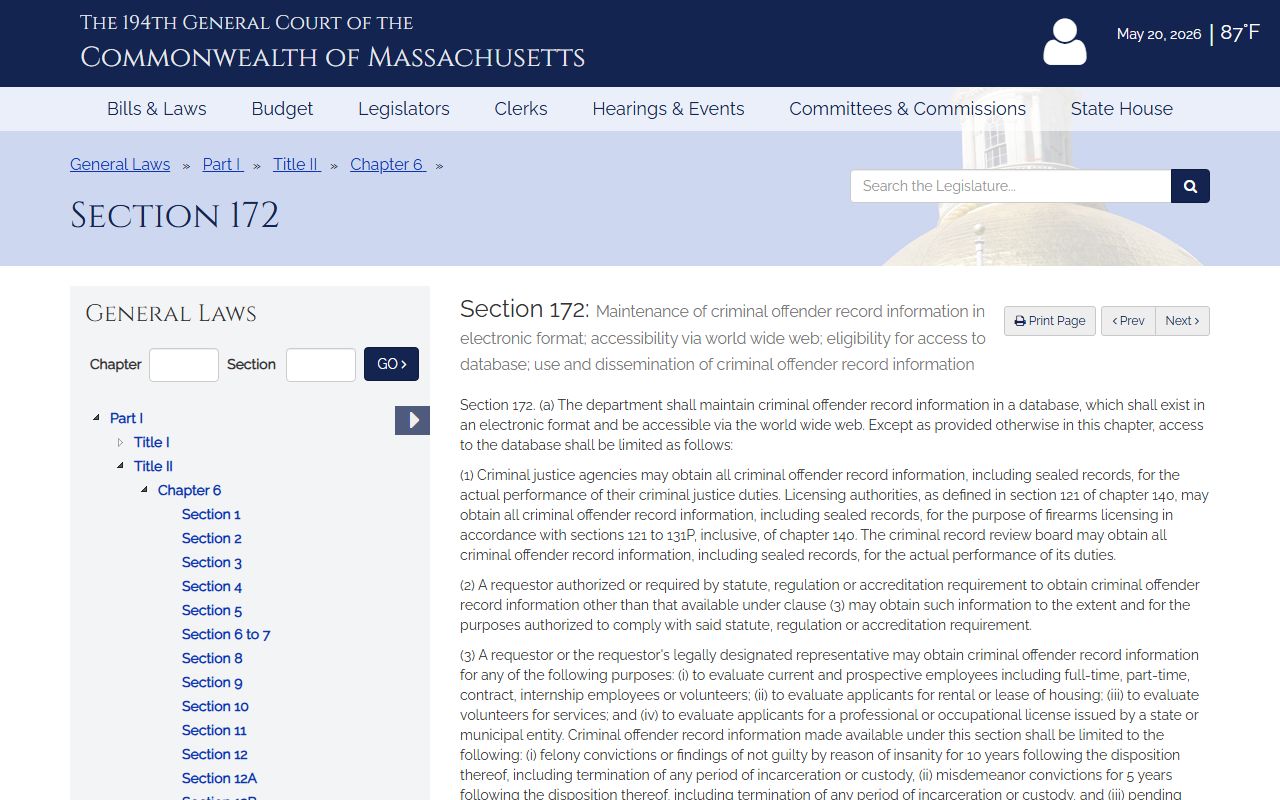
The CORI dissemination statute shown above, M.G.L. c. 6, § 172, controls access to criminal history. An individual can request their own CORI through the state.
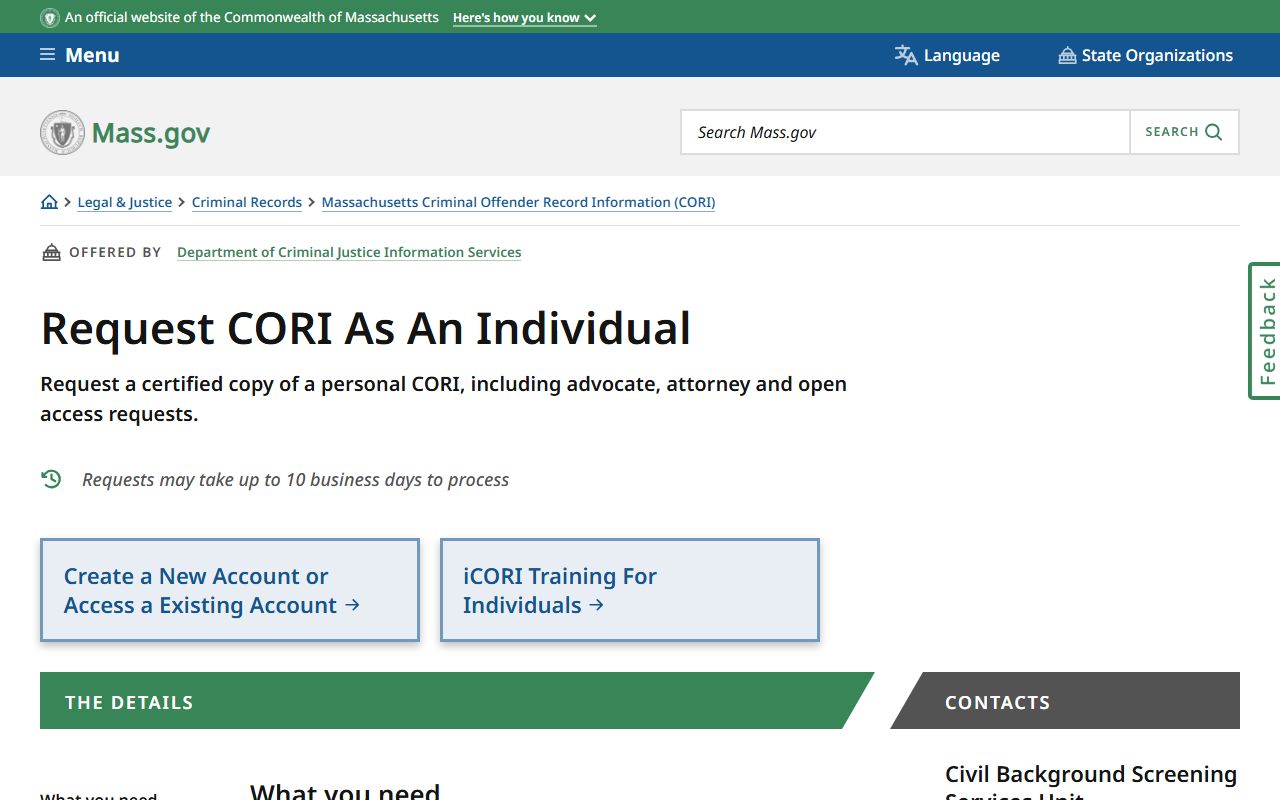
The state's request CORI as an individual page, pictured here, walks through the personal-request process and fees. A private background-check website is not a substitute and can be stale or wrong.
What a Suffolk County Criminal Record Shows
A criminal court record holds the docket and the case events. A booking record holds custody data. Together they can show the charge, the court, the dates, and the outcome. The fields below appear most often when you pull a Suffolk criminal case.
- Defendant and aliases where public.
- Charge and statute cited in the complaint or indictment.
- Court and docket number for the case.
- Arraignment, plea, and motion entries.
- Disposition and sentence if the case has ended.
Sealed records, juvenile records, and some non-conviction records may not appear publicly at all. A clean public search does not always mean a clean history.
Sealing a Suffolk County Criminal Record
Massachusetts lets some criminal records be sealed. Sealing removes a record from ordinary public access and limits CORI dissemination, though the record is not destroyed. Conviction sealing requires a waiting period and excludes some offenses. Non-conviction sealing can be available after a dismissal, a not-guilty finding, or a no bill.
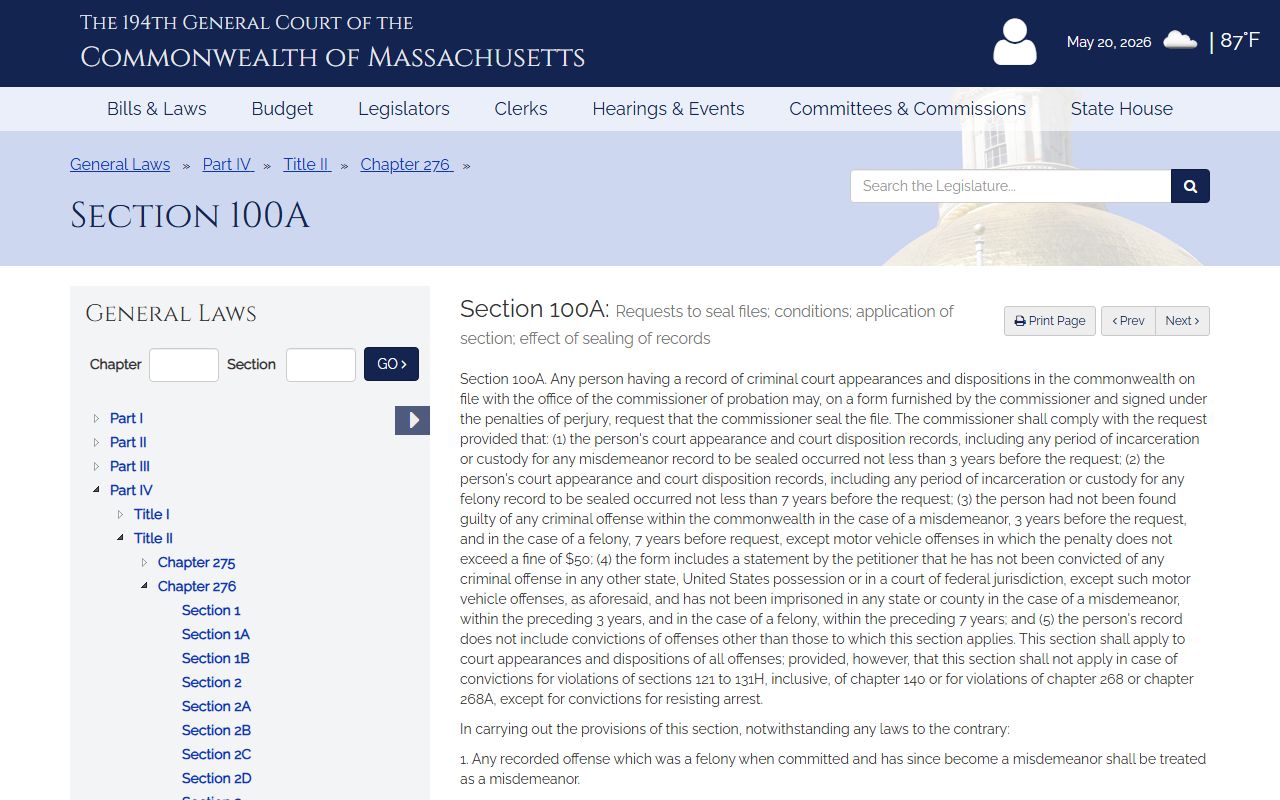
The waiting-period sealing statute above, M.G.L. c. 276, § 100A, governs eligible adult convictions. Non-conviction cases use M.G.L. c. 276, § 100B.
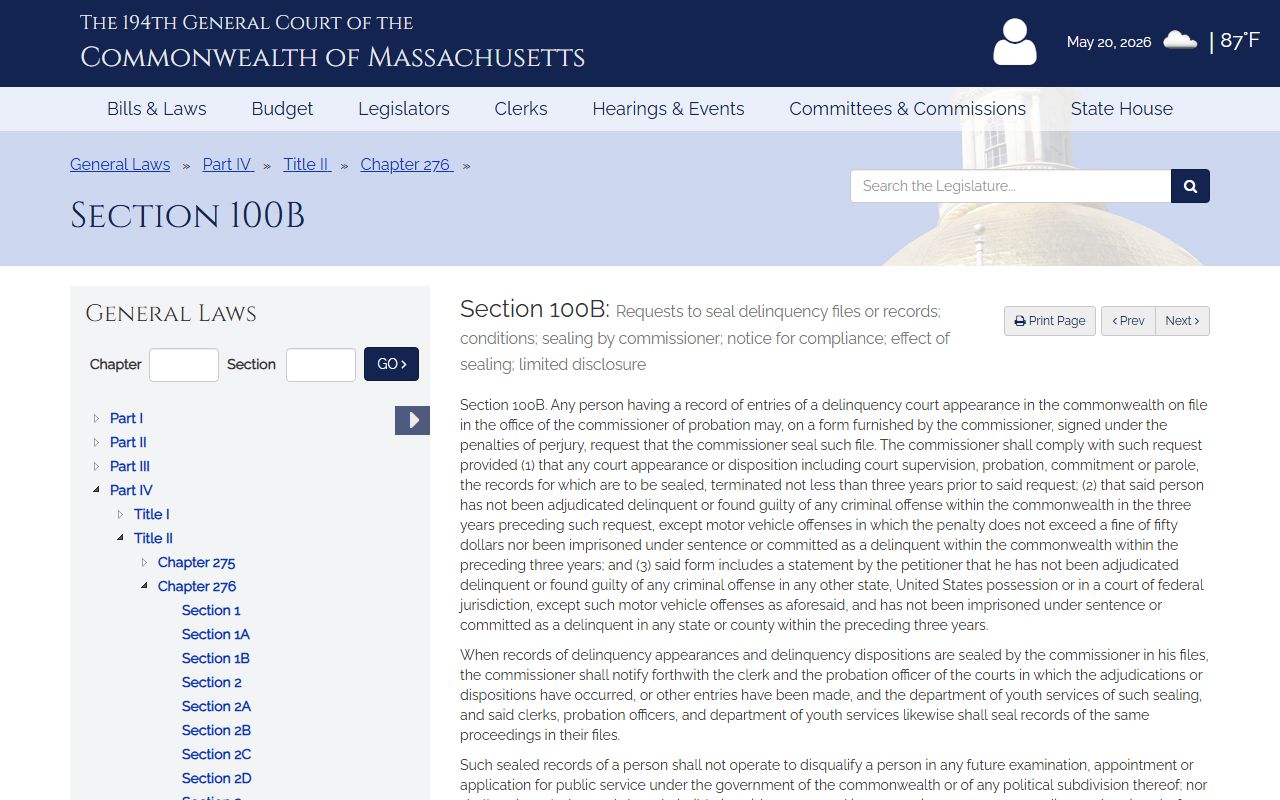
The statute shown above, section 100B, lets eligible Suffolk County records be sealed after a dismissal, a not-guilty finding, or a no bill, without the long waiting period that conviction sealing requires.
Sealed vs. Expunged Records
Sealing and expungement are not the same. Sealing hides a record from normal public access. Expungement removes it more completely, but it is allowed only on narrow statutory grounds. The comparison shows the difference.
| Point | Sealed | Expunged |
|---|---|---|
| Record kept? | Yes, but restricted | Removed or destroyed |
| Public access | Blocked | Blocked |
| Eligibility | Broader, with waiting periods | Narrow statutory grounds |
| Common basis | Time since case, non-conviction | Fraud, mistake, certain young-adult records |
Note: Sealing eligibility is fact-specific, so a person should confirm options with counsel or a sealing clinic before filing a petition.
The Suffolk County Booking Process
After an arrest in Suffolk County, police take the person to a station for booking or, after a court commitment, to a county facility. Booking confirms identity, inventories property, screens for medical and mental-health needs, takes photographs and fingerprints where allowed, and runs a warrant check. The arrest report and booking record are created here.
The timing of the first court appearance depends on the arrest time, the court schedule, bail-commissioner availability, and the charge. Bail can be personal recognizance, cash bail, conditions, or detention under a dangerousness procedure. If the person is committed, the Sheriff classifies them by security, medical need, and other factors before housing. Custody status is tracked separately from the court docket, which is why a search may need both.
Mugshots, Custody, and Warrants
Suffolk County does not publish a public mugshot gallery on the Sheriff's official site, and a booking photo is custody data rather than a public web feature. If a person is in custody, the better questions are which facility holds them and what their court status is.
For custody, see Suffolk County inmate records. For an outstanding warrant or default, see warrant records. A DUI or OUI charge is criminal and routes through the courts; the traffic court records page covers where those cases sit.
Prosecutor and Defense in Suffolk County
The Suffolk County District Attorney prosecutes state criminal cases arising in Boston, Chelsea, Revere, and Winthrop. The office runs trial, appeals, homicide, juvenile, and victim-witness units, plus diversion and reform programs. Federal crimes are prosecuted by the U.S. Attorney for the District of Massachusetts instead.
Indigent defense runs through the Committee for Public Counsel Services, not a county public defender office. A person seeking appointed counsel applies through the court, usually at arraignment, and must meet financial eligibility. The Boston Court Service Center can help with forms and process for those without a lawyer.