
Does Suffolk County Publish a Jail Roster?
Suffolk County does not appear to publish a full public, searchable jail roster with photos and charges on the Sheriff's official site. That is an important point, because many other counties do. Without a live roster, a Suffolk County inmate search relies on custody-notification tools, facility contact, and court records.
The first question to settle is where the person is held. Different systems answer different parts of it. County jail custody is checked through VINELink and the Sheriff. State prison custody uses the Massachusetts Department of Correction locator. Federal custody uses the Bureau of Prisons locator. Picking the right system saves a lot of dead ends.
Because Suffolk does not post a roster, families sometimes turn to third-party jail sites that claim to list county inmates. Those sites are not official, and they can show stale or wrong data. They should not be trusted for custody, charges, or release dates. The official tools below are slower to read but accurate, and they are free.
How to Run a Suffolk County Inmate Search
Start with the most likely system, then confirm through a second source if timing matters. Custody data can lag after an arrest, a court date, a transport, or a transfer, so verify before traveling or sending money.
- Decide whether the person is likely in county jail, state prison, or federal custody.
- For county custody, search VINELink Massachusetts by name.
- Check the court docket for a bail or commitment order.
- For state prison, use the Massachusetts DOC inmate locator.
- For federal custody, use the BOP inmate locator.
- Call the holding facility to confirm before a visit or deposit.
If the person was just arrested, the first public clue is often the court arraignment, covered on the arrest records page, rather than a jail listing.
VINELink Custody Search for Suffolk County
VINELink is the state's free custody-notification system. It can show custody status where the facility participates and lets you register for alerts about a change. It is the closest thing to a public county-custody search in Massachusetts.
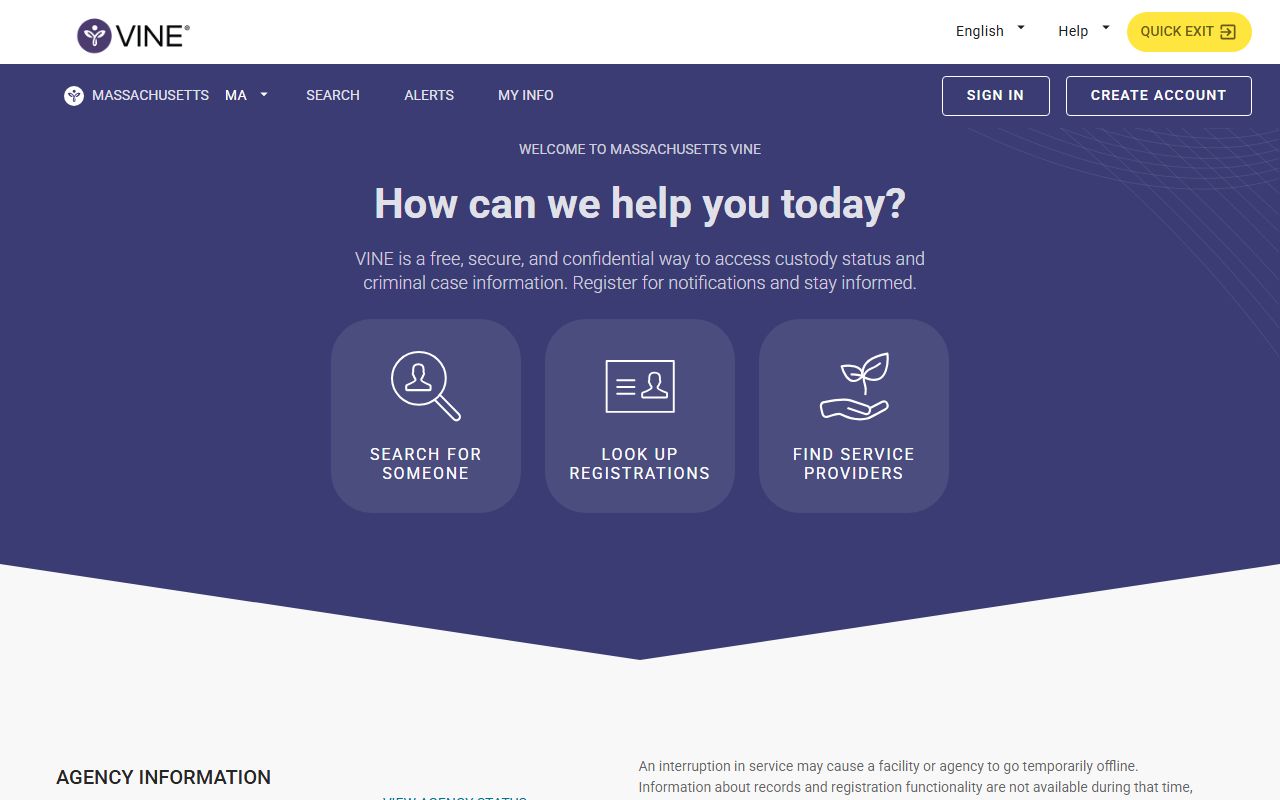
The VINELink Massachusetts portal, shown above, supports name searches and notification sign-up. The fields below show what a VINELink search asks for.
| Field | Type | Required | Notes |
|---|---|---|---|
| State | dropdown | Yes | Massachusetts selected. |
| Last Name | text | Yes | Try the exact legal surname and known aliases. |
| First Name | text | Optional | Pair with the last name for a better match. |
| Offender / Booking ID | text | Conditional | Use if known. |
| Register for notification | button | Optional | Requires phone or email and a PIN. |
VINELink shows custody, not active warrants. For warrant questions, see warrant records.
State Prison vs. Suffolk County Jail
County jail and state prison are not the same. The Suffolk Sheriff holds pretrial detainees and people serving shorter house-of-correction sentences. People sentenced to longer terms go to state prison, run by the Massachusetts Department of Correction. If a person is not in county custody, the DOC locator is the next stop.
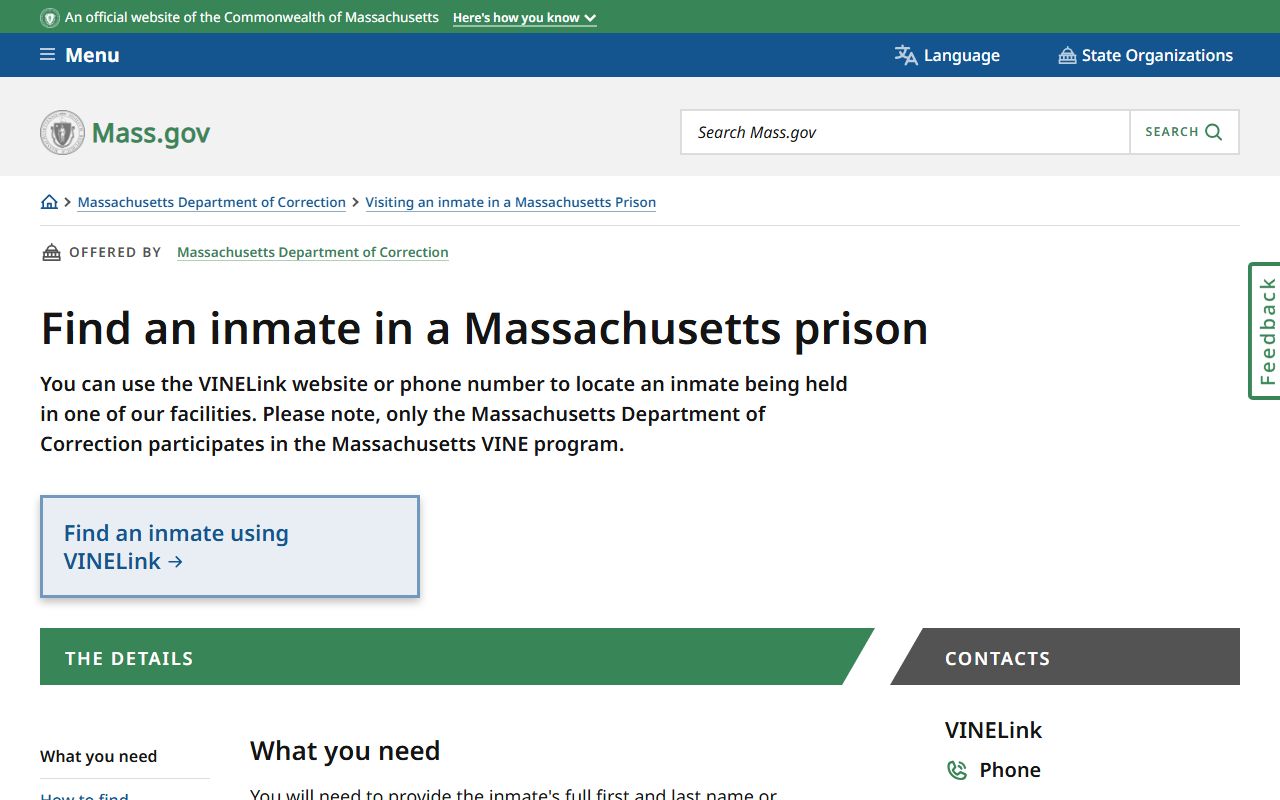
The state's find an inmate in a Massachusetts prison guide, pictured here, explains the DOC search. It uses a name or commitment number, not county booking data.
Federal Inmate Search
If the person is in federal custody, neither the Sheriff nor the DOC will show them. Federal sentenced inmates are searched through the Bureau of Prisons locator. Federal pretrial custody can run through the U.S. Marshals, sometimes housed in contract facilities, so federal case systems are the better guide for federal defendants.
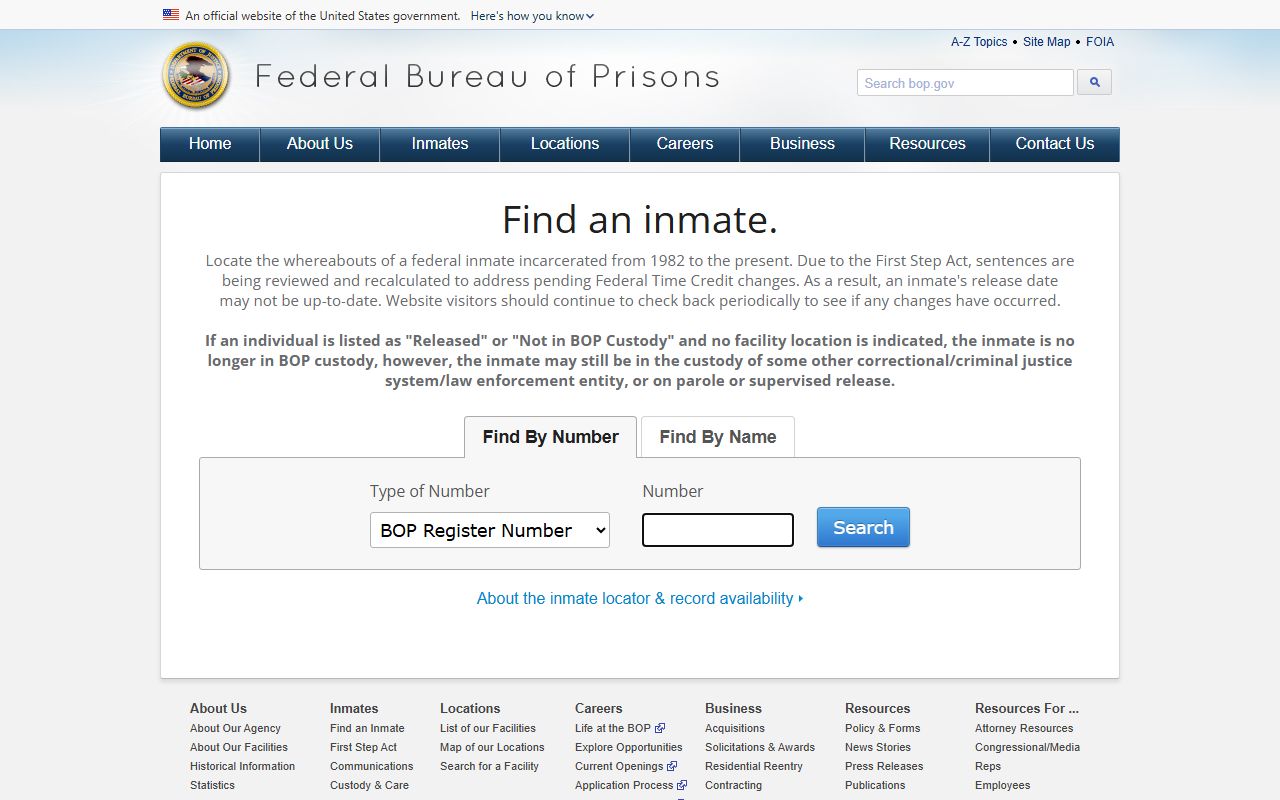
The BOP inmate locator above searches by register number or by name with race, sex, and age. It covers federal inmates only, not county jail.
Registry Status Is Not Custody Status
People sometimes confuse the sex offender registry with a custody search. They are different. The Massachusetts Sex Offender Registry Board lists classified offenders by public rules, but a registry entry says nothing about whether a person is currently in jail. A person can be on the registry and free, or in custody and not on the registry.
So use the registry for registry questions and the custody tools for custody questions. The registry search runs by name or by city and town, including Boston, Chelsea, Revere, and Winthrop. Registry information also carries a legal warning that it cannot be used to harass or threaten anyone. For current custody, stay with VINELink, the facility, the DOC locator, or the BOP locator.
Suffolk County Jail Facilities
The Sheriff's Department runs two main facilities in Boston. Nashua Street Jail holds mostly pretrial detainees. South Bay House of Correction holds sentenced and pretrial people plus program units. Confirm which facility holds a person before any visit, because schedules and rules differ.
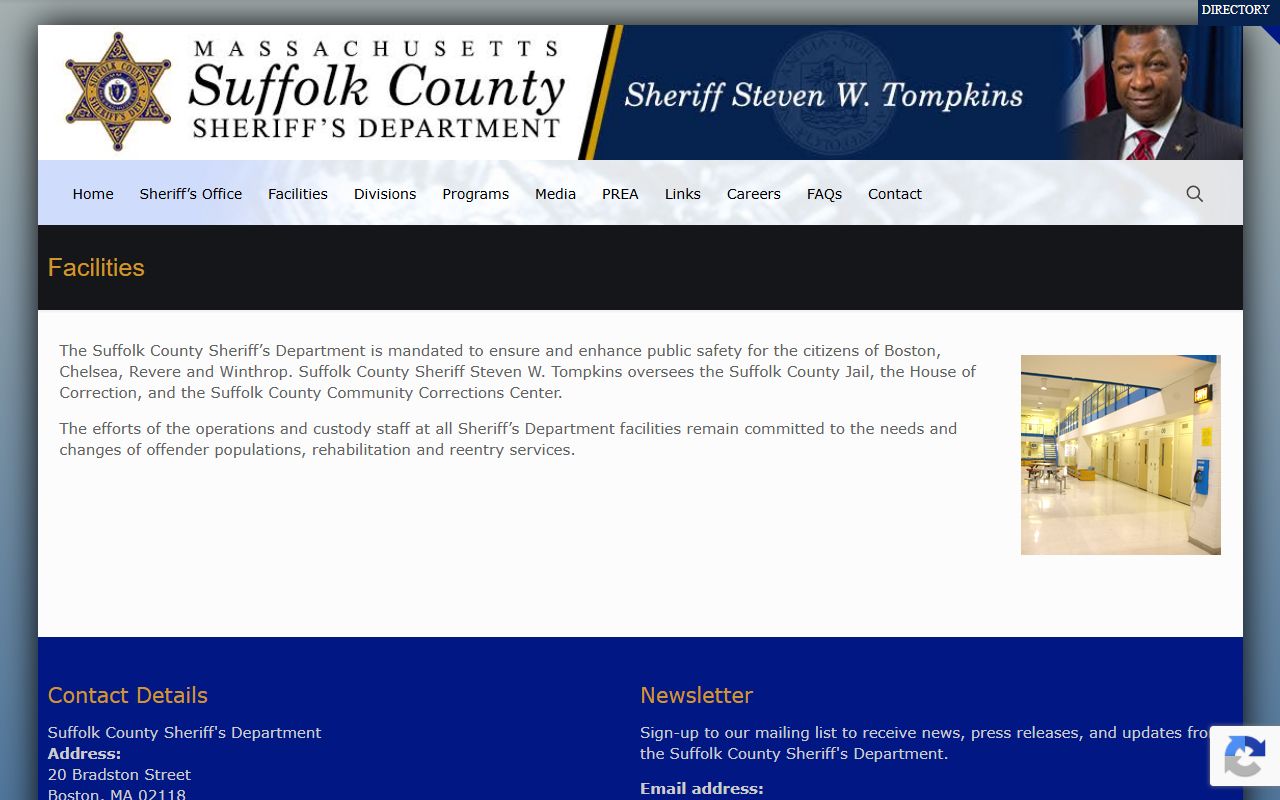
The Sheriff's facilities page, shown here, is the official source for both buildings and the right place to confirm current contact details.
Why a Suffolk Custody Search Can Lag
Custody systems do not update in real time. There is a gap between a real-world event and the moment it shows on a screen. A person can be arrested, arraigned, transported, bailed, or transferred hours before any public system reflects it. That lag is the single biggest reason a Suffolk County inmate search returns confusing or empty results.
So timing matters. If a search comes up empty right after an arrest, the booking may not be entered yet, and the court arraignment may be the first record to appear. If a search shows someone in custody but a family member heard about a release, the system may simply be behind. When the answer affects travel, money, or safety, confirm with the facility by phone and check the court docket as a second source. One system rarely tells the whole story on its own.
A few common reasons a name does not appear: the spelling differs from the legal name, the person used an alias, the person is in a different system than expected, or the record is restricted. Try the legal surname first, then known aliases, before assuming the person is not in custody.
What a Suffolk Custody Profile Shows
Public custody data is limited. A VINELink-style result may show only name, status, and facility. Detailed booking, medical, and classification data is not posted publicly. The table lists the fields a custody result may include.
| Field | What It Shows |
|---|---|
| Name | Full name or custody display name. |
| Offender / Booking ID | May appear if the agency shares it. |
| Custody Status | In custody, released, transferred, or unknown. |
| Facility | The holding agency or correctional facility. |
| Scheduled Release | Sometimes blank or unavailable. |
| Charges | May be limited, summarized, or absent. |
A mugshot is not consistently shown, and pod or cell location is not public. For court status, the docket is the better source.
Booking and Classification
After a court commitment, a person is transported to a county facility for intake. Booking confirms identity, inventories property, and screens for medical and mental-health needs. Classification then separates people by security risk, medical need, gender, protective-custody concerns, and program status before a housing assignment.
Court appearances after commitment may happen by transport or by video where allowed. The custody system and the court docket track different things, which is why a full picture often needs both. See the jail population data page for facility-level context.
Bail in Suffolk County can take several forms. It may be personal recognizance, where the person promises to return; cash bail set at an amount; conditions of release; or detention under a dangerousness procedure with no bail. The bail decision shapes whether a person stays in county custody at all. A bail order shows on the court docket, which is why the docket is often the quickest way to learn custody status after a first court appearance.
Visitation, Mail, and Money
The Sheriff publishes its own visiting, mail, and deposit rules, which beat any third-party site. Confirm the rules immediately before acting, because lockdowns, housing status, and emergencies can change availability. The table summarizes the categories to check.
| Topic | What to Confirm |
|---|---|
| Scheduling | Whether the visit needs scheduling and approval. |
| Identification | Valid government photo ID for adults. |
| Children | Adult supervision and proof of relationship. |
| Dress code | Conservative attire; no clothing that mimics uniforms. |
| No cash, contraband, or prohibited content; mark legal mail. | |
| Money | Use the Sheriff's official vendor and instructions. |
Note: Hours and rules differ by facility and housing unit, so confirm them on the Sheriff's official pages before you travel or send funds.
Bail, Release, and Attorney Contact
Custody can end in several ways: release on recognizance, release after bail, dismissal, sentence completion, or transfer to state or federal custody. The court docket shows bail and release orders, though it may not update at the same speed as jail processing. For release verification, see released inmates.
Attorney visits are professional visits handled separately from social visits. Defense counsel, or CPCS for those who qualify, can confirm custody and court status and arrange contact. Families needing urgent medical or safety help should reach the facility through official channels with the person's full name and case information.
Victims have their own tools. VINELink lets a victim register for an alert when custody status changes, and the Suffolk County District Attorney's victim-witness unit can help with safety planning and case updates. Those services exist so a person does not have to keep checking a screen by hand. The point across every role, family member, attorney, employer, or victim, is the same: rely on the official system that fits the question, and verify before acting on a single result.