
How Marriage and Divorce Records Are Split
Massachusetts handles marriage and divorce in different places. Marriage law is in M.G.L. c. 207, and a license is issued locally by the city or town clerk. Divorce law is in M.G.L. c. 208, and the case is filed in Probate and Family Court. So for a Boston couple, the marriage license comes from the City of Boston Registry Division, while a divorce would later go to Suffolk Probate and Family Court. A Chelsea marriage uses the Chelsea city clerk; a Revere or Winthrop marriage uses that town's clerk.
This split matters for record searches too. A certified marriage certificate comes from the city or town where the couple filed intentions, not from the court. A certified divorce judgment comes from Probate and Family Court, not the city. Searching the wrong office wastes a trip and a fee.
How to Apply for a Boston Marriage License
Boston handles marriage license applications through the City of Boston Registry Division at Boston City Hall. The process is local and walks the couple through identity confirmation, filing intentions, the state waiting period, and license issuance. The official Boston Registry Division page is the right starting point.
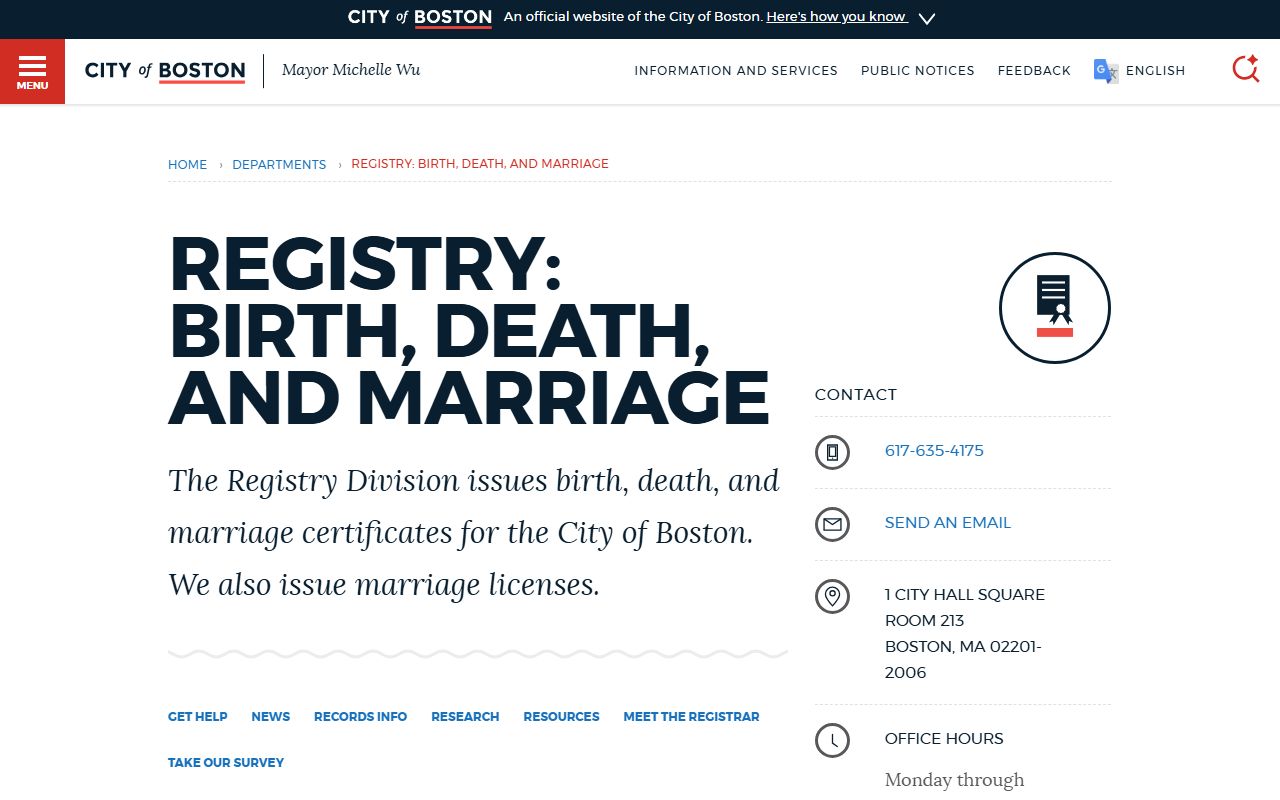
The Registry Division page above is the city office that issues Boston marriage licenses and holds the certificates after the ceremony is registered.
- Review the official Boston marriage license instructions.
- Schedule or complete the required Boston Registry process.
- Bring required identification and personal information.
- Pay the current city fee listed by Boston.gov.
- Observe the Massachusetts waiting period unless a court waiver applies.
- Have the ceremony performed by an authorized officiant.
- Return the completed license to the issuing office for registration.
- Order certified marriage certificates from the city where the license was filed.
Massachusetts does not require a blood test for marriage. The marriage law itself is at M.G.L. c. 207.
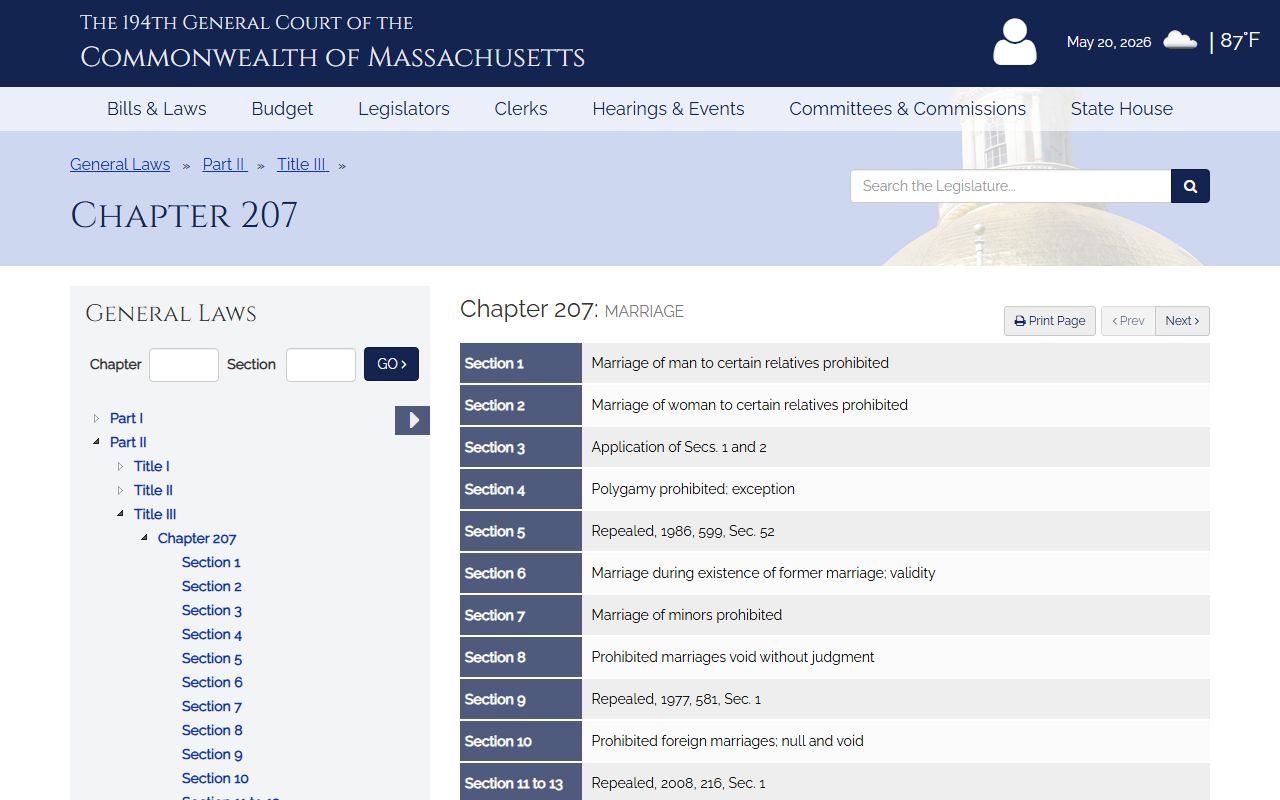
The marriage statutes shown above set the eligibility, license, and ceremony rules that the Boston Registry applies to every Suffolk County marriage.
Marriage License Application Fields
The license application asks both applicants for identity and personal information. The table lists the typical fields. Bring documents that match the legal names on the application; small mismatches slow the process.
| Field | Type | Required | Notes |
|---|---|---|---|
| Applicant 1 legal name | text | Yes | Full legal name. |
| Applicant 2 legal name | text | Yes | Full legal name. |
| Date of birth or age | date | Yes | Used for legal eligibility. |
| Address | text | Yes | Residence information. |
| Parent information | text | Yes | Required by vital record forms. |
| Prior marriage status | checkbox | Yes | Divorce, death, or annulment information if applicable. |
| Identification | document | Yes | Government ID per Boston Registry rules. |
| Ceremony date and officiant | text | Conditional | Completed when the license is returned. |
Marriage Certificate Copies in Suffolk County
A marriage certificate is ordered after the completed license has been returned and registered. The place where the couple filed intentions controls where the certificate is recorded, so a ceremony location alone is not always the records office. For Boston intentions, the Boston Registry copy request page lists the process and identification rules.
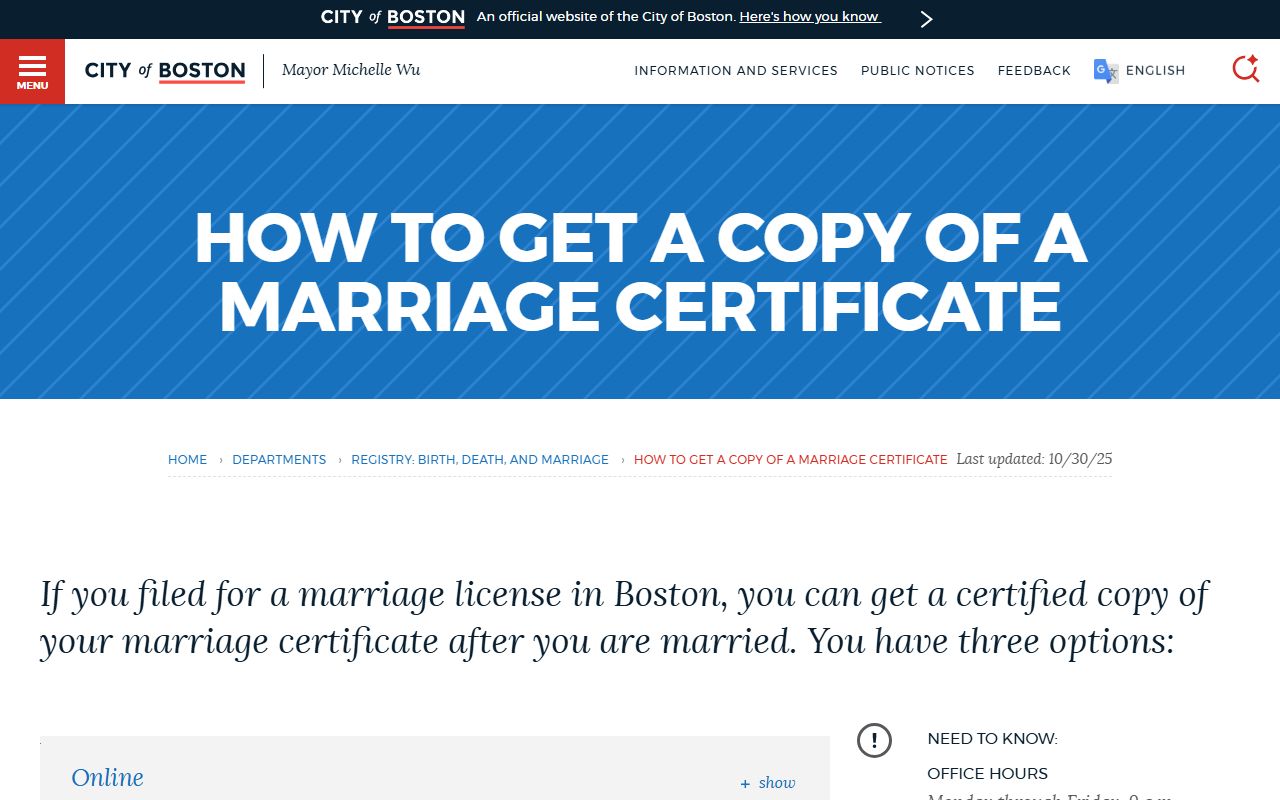
The official Boston certificate page above carries the current fee and accepted payment options. Couples who filed intentions in Chelsea, Revere, or Winthrop should contact that town's clerk for the certificate instead.
Divorce in Suffolk Probate and Family Court
All Suffolk County divorces are filed in Suffolk Probate and Family Court. The court sits at 24 New Chardon Street in Boston, with a satellite at 120 Broadway in Chelsea. The Boston office is open Monday through Friday, 8:30 a.m. to 4:30 p.m. The phone is 617-788-8350; fax 617-788-8962. The divorce statute is at M.G.L. c. 208.
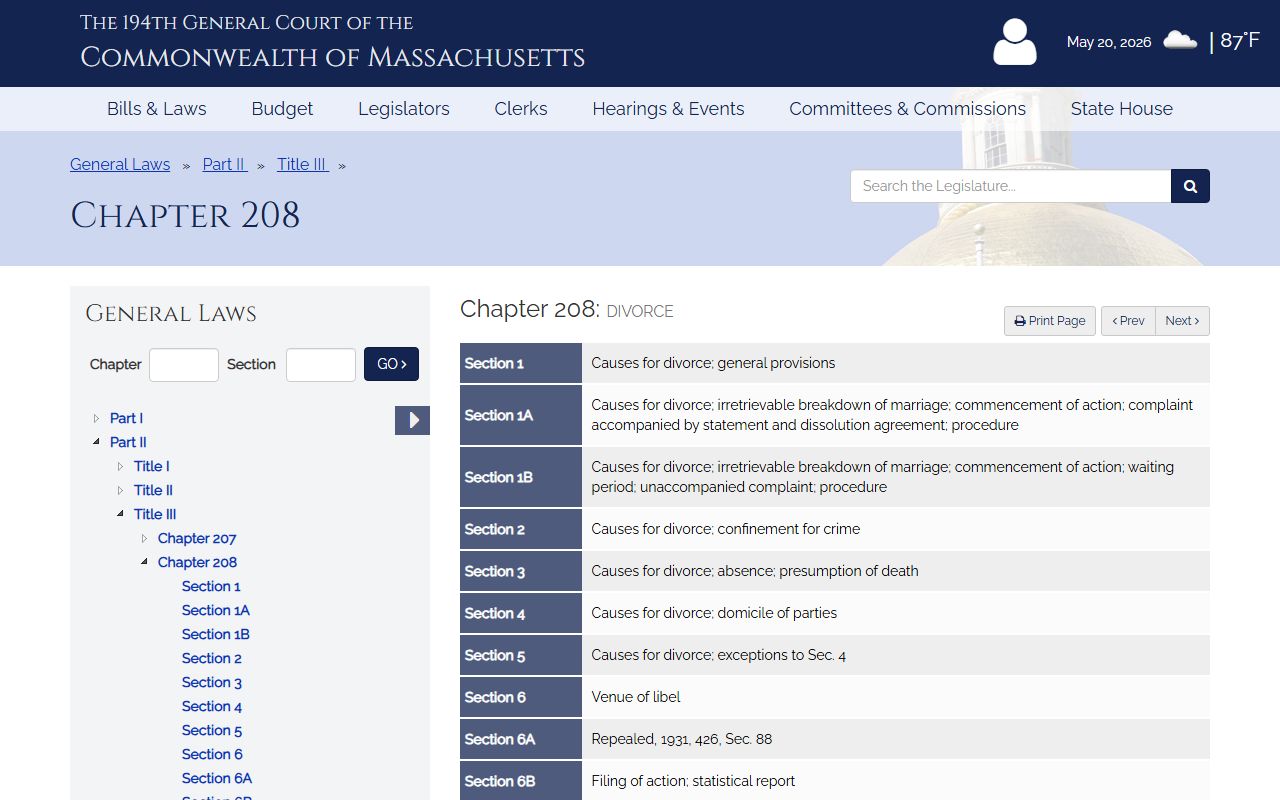
The divorce chapter shown above governs grounds, alimony, custody, support, property division, and judgments. Massachusetts allows no-fault divorce based on irretrievable breakdown of the marriage, and fault grounds still exist but are less common.
How to File for Divorce in Suffolk County
The right path depends on whether the case is uncontested or contested. A joint petition is used for many uncontested divorces. A complaint for divorce starts a contested case. Both routes use Trial Court forms and require service or notice to the other party.
- Confirm Suffolk Probate and Family Court is the right venue.
- Choose the complaint type: joint petition, complaint for divorce, or other family-law filing.
- Prepare Trial Court forms, the marriage certificate, financial statements, and any child-related forms.
- File with the Probate and Family Court and pay the filing fee or request a waiver.
- Serve the other party if required.
- Attend case management, pretrial, and final hearings as scheduled.
- Order certified copies of the judgment or decree once the case is final.
The probate records page covers other Probate and Family Court matters such as estates and guardianships.
Certified Divorce Decrees and Documents
A divorce file holds several documents, not just one. A complaint for divorce starts a contested case. A joint petition is used for some uncontested cases. A financial statement is a sensitive financial disclosure. A separation agreement is the contract or order resolving property, support, and custody. The judgment or decree is the court's final divorce order. The certificate of divorce absolute is proof the divorce became final.
To order copies, contact the Probate and Family Court register. Give both spouses' names, the docket number if known, the approximate year of the divorce, and the exact item you need. A clerk can search more efficiently for a "certified judgment in a 2022 Suffolk Probate divorce" than for vague "records."
Suffolk Marriage and Divorce Record Fees
Fees depend on the office and the document. Court fees are set by Trial Court schedules and statute, while city marriage fees are set by Boston and the other town clerks. The table below lists the fee categories without inventing specific dollar amounts; always confirm the current fee with the issuing office before ordering.
| Item | Fee Note |
|---|---|
| Boston marriage license | City fee posted by the Boston Registry Division. |
| Boston marriage certificate copy | Order instructions and current fee on Boston.gov. |
| Divorce filing fee | Set by Trial Court schedules; waivers available for indigent filers. |
| Certified divorce judgment | Fee set by the Probate and Family Court register, confirm with the office. |
Fee waivers, called affidavits of indigency, can apply when a person cannot pay court filing or copy fees. Ask the court for the form when you file.
Restricted Family Records
Not every part of a divorce file is public. Probate and Family Court financial statements and account numbers are often restricted or redacted. Child-related information, GAL reports, adoption records, and protected-address data may be limited. Abuse-prevention orders include safety-sensitive material and may be impounded.
Adoption records are confidential under M.G.L. c. 210, § 5D. Access requires statutory eligibility or a court order. The court records page covers public access rules and SJC Rule 1:24 in more detail.
Note: A clerk's official record controls over an online docket summary; confirm a marriage or divorce detail with the issuing office before relying on it.