
How to Search Suffolk County Court Records
The main public tool for Suffolk County court records is MassCourts eAccess, the Massachusetts Trial Court's free electronic case search. It is a statewide site, not a county-only one. That matters here. "Suffolk County" is not a single database, so the court department you pick controls what comes back. Pick the wrong one and a real case can look like it does not exist. Before you start, know the party's full legal name or the case number, and have a rough idea of which court heard the matter.
Most searches start with a name. If you have a docket or citation number, that path is faster and more exact. The portal shows case information and docket entries, but it is not a document download site. Many pleadings, orders, and decrees still require a request to the clerk. The steps below follow the public MassCourts flow.
The Trial Court explains its search rules and access limits on the MassCourts public eAccess portal, which is the starting page for almost every Suffolk case lookup.
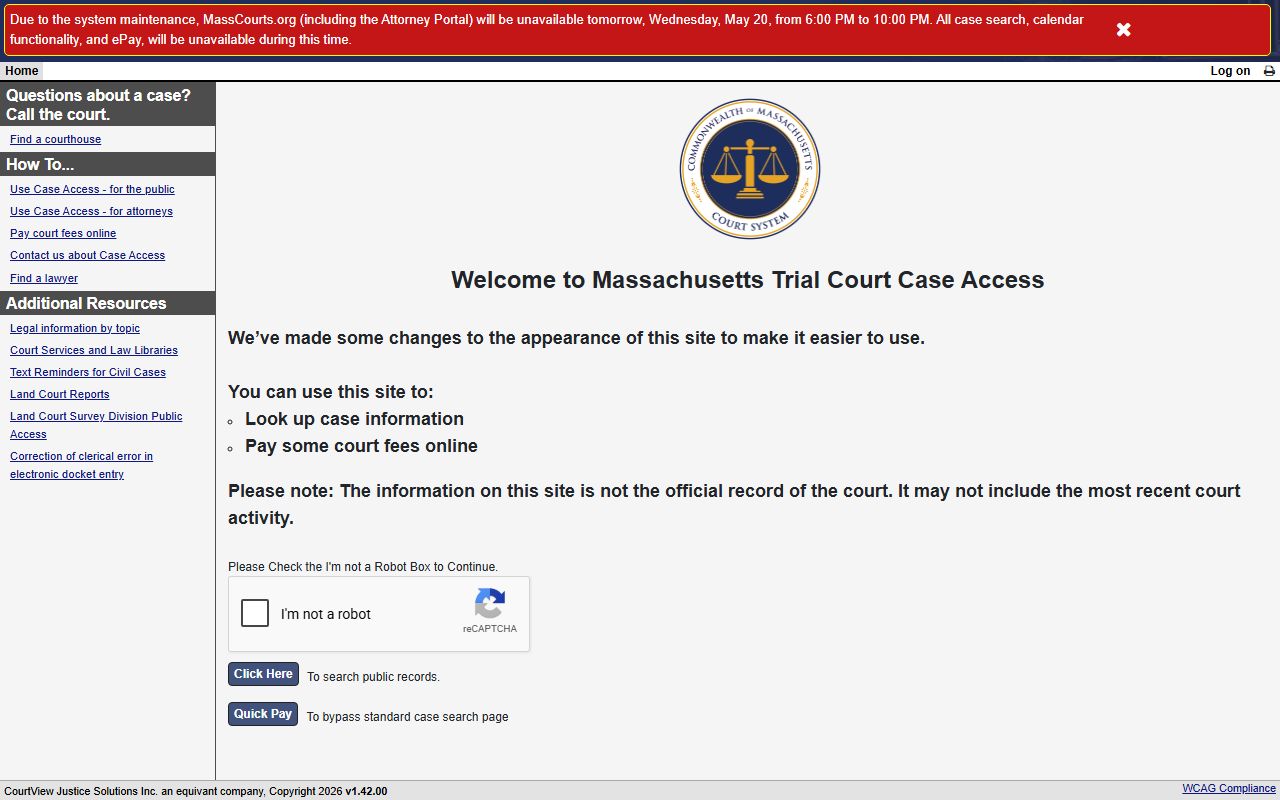
The portal home screen, shown above, is where you choose a department and a search type before you ever type a name. The same screen carries the notices that explain why some Suffolk cases are restricted from public view.
- Open the portal at masscourts.org and read the public-access notices first.
- Select the Trial Court department, such as Superior Court, Probate and Family Court, or Boston Municipal Court.
- Select the Suffolk division, then choose name search or case-number search.
- Enter the last name first; test business names with and without punctuation.
- Open a result row to view the docket, then call or visit the clerk for certified copies.
How Suffolk County Court Records Are Organized
Massachusetts does not give Suffolk County one clerk who controls every record. The state runs a unified Trial Court split into departments, and the clerk, register, or recorder for each department keeps that department's files. So a felony indictment, a divorce decree, and a recorded deed live in three different offices, even though all are "Suffolk County" records.
For Superior Court cases, the Suffolk County Superior Court Clerk's Office at 3 Pemberton Square in Boston is the local office. Divorce, custody, estate, and guardianship files sit with the Suffolk Probate and Family Court registry. Deeds and mortgages are not court case files at all; they are kept by the Suffolk County Registry of Deeds. A Boston marriage license comes from the City of Boston Registry Division. The Massachusetts Court System page lists every department and how they fit together.
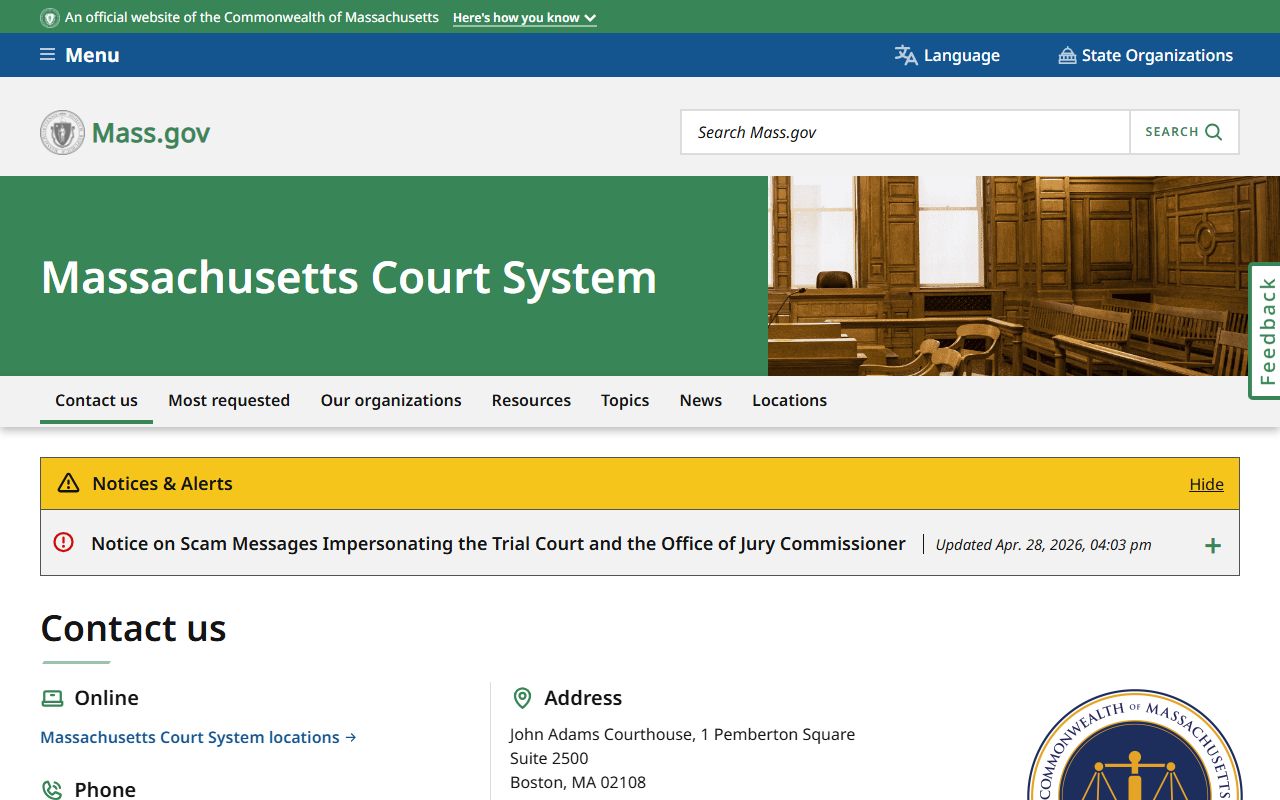
That state page, pictured here, is the cleanest map of how the Trial Court is built. It helps explain why a "Suffolk County clerk" search may send you to several offices instead of one counter.
| Office | Records Handled | Where |
|---|---|---|
| Suffolk County Superior Court Clerk | Felony, major civil, equity | 3 Pemberton Square, Boston |
| Suffolk Probate and Family Court | Divorce, estates, guardianship | 24 New Chardon St., Boston |
| Suffolk County Registry of Deeds | Deeds, mortgages, liens, plans | 24 New Chardon St., Boston |
| City of Boston Registry Division | Birth, marriage, death records | 1 City Hall Square, Boston |
Each office has its own request process and fees. Start by matching the record type to the office, then go to that office's clerk. More detail sits on the Suffolk County Clerk of Court page and the Registry of Deeds page.
The Suffolk County Court System
The Massachusetts court system runs from the top down. The Supreme Judicial Court is the highest court. The Appeals Court is the main intermediate appellate court. Below them sits the Trial Court, which is what most people mean by "Suffolk County Court." The Trial Court departments hear the cases; the appellate courts review them.
Superior Court is the general-jurisdiction trial court. It takes first-degree murder, felonies, large civil claims, and equity matters. Boston Municipal Court and the District Court Department handle many misdemeanors, small claims, summary process, and civil motor vehicle infractions. Probate and Family Court covers divorce, support, estates, and guardianship. Housing Court hears evictions and code matters. Land Court handles registered land and title disputes.
Case flow: Boston Municipal Court / District Court › Superior Court › Appeals Court › Supreme Judicial Court
| Court | Jurisdiction | Case Types |
|---|---|---|
| Superior Court | General, statewide | Felony, major civil, equity |
| Boston Municipal Court | Boston neighborhoods | Misdemeanor, small claims, traffic |
| Probate and Family Court | Family and probate | Divorce, estates, guardianship |
| Housing Court | Housing matters | Eviction, code enforcement |
| Land Court | Statewide real estate | Title, tax lien, zoning appeals |
Federal cases from Suffolk County are separate. They go to the U.S. District Court for the District of Massachusetts, not the state Trial Court. The Suffolk County Superior Court page breaks down trial-court jurisdiction in more depth.
Suffolk County Courthouses
Suffolk County's court footprint spreads across downtown Boston's Government Center and Beacon Hill area. The Superior Court at 3 Pemberton Square is the building most people picture when they think of the county court. Probate, family, and many municipal matters use other addresses nearby. Use the specific court's location page before you travel, because the wrong building wastes a morning.
The Suffolk County Superior Court location page lists current hours, the clerk's phone, and the civil and criminal clerk units.
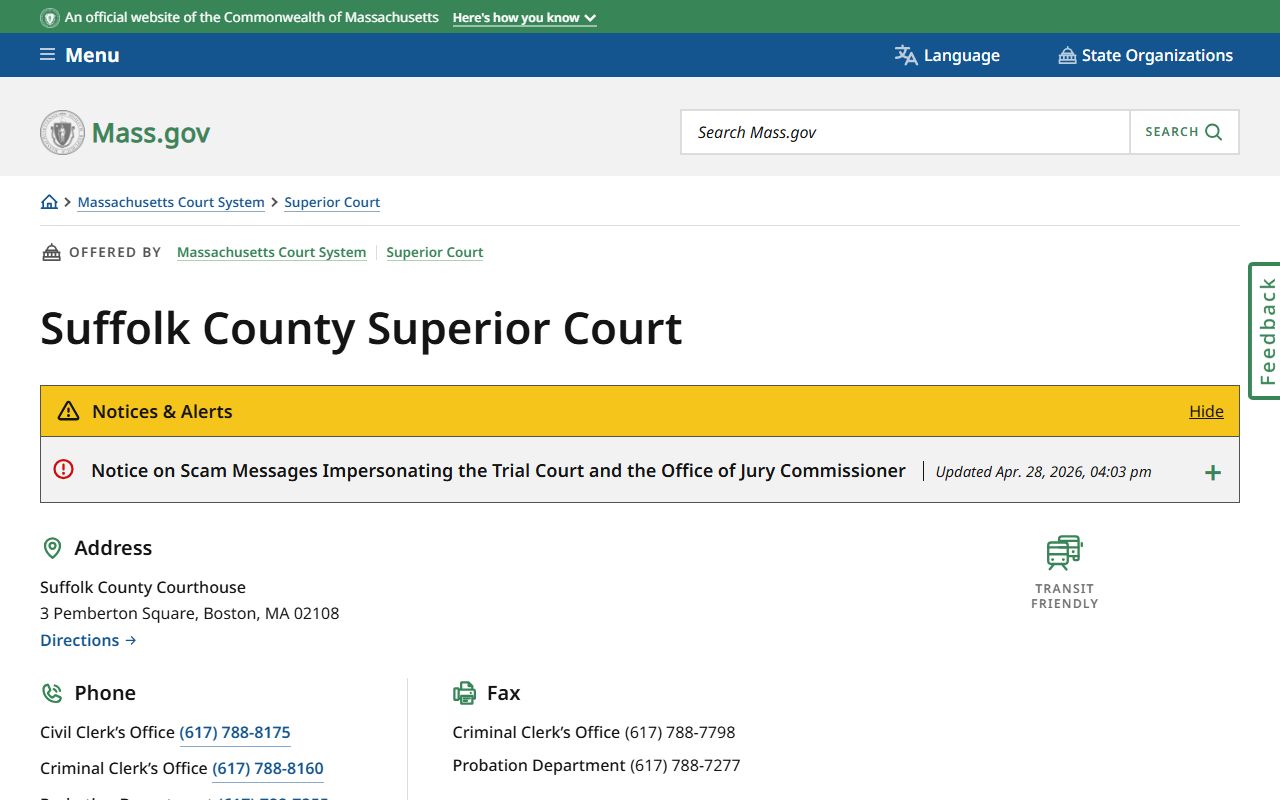
The official location page above carries the address and phone in one place, which is safer than relying on a map pin alone.
Public hours at the Superior Court and the Boston Probate office run Monday through Friday, 8:30 a.m. to 4:30 p.m. The Chelsea satellite keeps shorter hours, Tuesday through Thursday. Confirm before a trip, since holidays and court orders shift schedules.
Types of Court Records Available in Suffolk County
Suffolk County court records cover the full range of state cases. The kind of file depends on which department heard the matter. A Superior Court criminal docket does not look like a Probate estate file, and a small claims case does not look like a Land Court title dispute. Most records are public, but sealing, impoundment, and confidentiality rules pull some out of public view.
These are the record types people search most often in Suffolk County.
- Criminal records - indictments, dockets, pleas, and dispositions, limited by CORI and sealing law.
- Civil records - complaints, judgments, small claims, and summary process files.
- Family and divorce records - divorce, custody, and support files in Probate and Family Court.
- Probate records - wills, estates, guardianship, and conservatorship cases.
- Traffic records - civil motor vehicle infractions and criminal traffic matters.
For the deep version of each type, see the Suffolk County court records page and the court dockets page.
What Suffolk County Court Records Show
A Suffolk County court record is built around the docket. The docket is a dated log of every filing, hearing, and order in the case. Public portal data is best read as an index and summary, not the full file. The fields below appear on a typical public case detail, though the exact set changes by department.
| Field | What It Shows |
|---|---|
| Case Number | Department docket number, often year plus a court code and sequence. |
| Filing Date | Date the complaint, indictment, or petition opened the case. |
| Parties | Names and roles: Commonwealth, plaintiff, defendant, petitioner, decedent. |
| Charges / Cause | The criminal charge or the civil cause of action. |
| Disposition | Current or final outcome: dismissed, judgment, guilty, allowed. |
| Sentence / Judgment | Sentence terms, money judgment, or decree where entered. |
Protected items stay out of the public copy. Social Security numbers, full dates of birth, financial account numbers, minor names, and addresses sealed by order are redacted. If a docket entry looks blank or missing, the file may be impounded rather than gone.
Public Access Laws for Suffolk County Court Records
Massachusetts splits access into two tracks. Records held by executive agencies, like the Sheriff's administrative files, fall under the Public Records Law. Court case files follow court rules, mainly SJC Rule 1:24, plus statutes that make certain records confidential. So a request to the Sheriff is a public records request, while a request for a divorce decree is a court-record request to the register.
Key Statutes and Rules:
M.G.L. c. 66, § 10 - sets how to ask a public agency for records and how fast it must answer.
M.G.L. c. 6, § 172 - controls who may get criminal offender record information, known as CORI.
M.G.L. c. 276, § 100A - allows eligible adult criminal records to be sealed after a waiting period.
SJC Rule 1:24, the central court-record access rule, explains why a MassCourts search shows docket information but not every filed document. The Suffolk County public records page walks through the request process and appeal rights in full.
Records That Are Restricted or Confidential
Not every Suffolk County record is open. Massachusetts uses sealing, impoundment, statutory confidentiality, CORI controls, and redaction. Juvenile delinquency files, adoption records, mental health proceedings, and grand jury material are closed or tightly limited. Sealed adult criminal records drop out of ordinary public access, and CORI dissemination shrinks once sealing is granted.
To view a sealed or impounded record, a person usually needs party status, counsel, or a court order. A sealed record is not destroyed; it is hidden from normal access. Expungement goes further but is allowed only on narrow statutory grounds. The Suffolk County arrest records page covers sealing eligibility and the petition process step by step.
Specialty Courts in Suffolk County
Suffolk County uses several problem-solving court sessions. Drug or recovery court gives eligible defendants with substance-use disorders frequent judicial review, probation supervision, treatment, and drug testing in place of a standard sentence. Mental health court uses treatment plans and regular monitoring for defendants whose conduct ties back to mental health needs.
Veterans treatment sessions connect eligible veterans to VA benefits, treatment, and mentoring. The Suffolk County District Attorney also runs diversion and restorative-justice tracks. Eligibility is case-specific and policy-driven, so a defendant should ask defense counsel, probation, or the session clerk rather than assume a program is open.
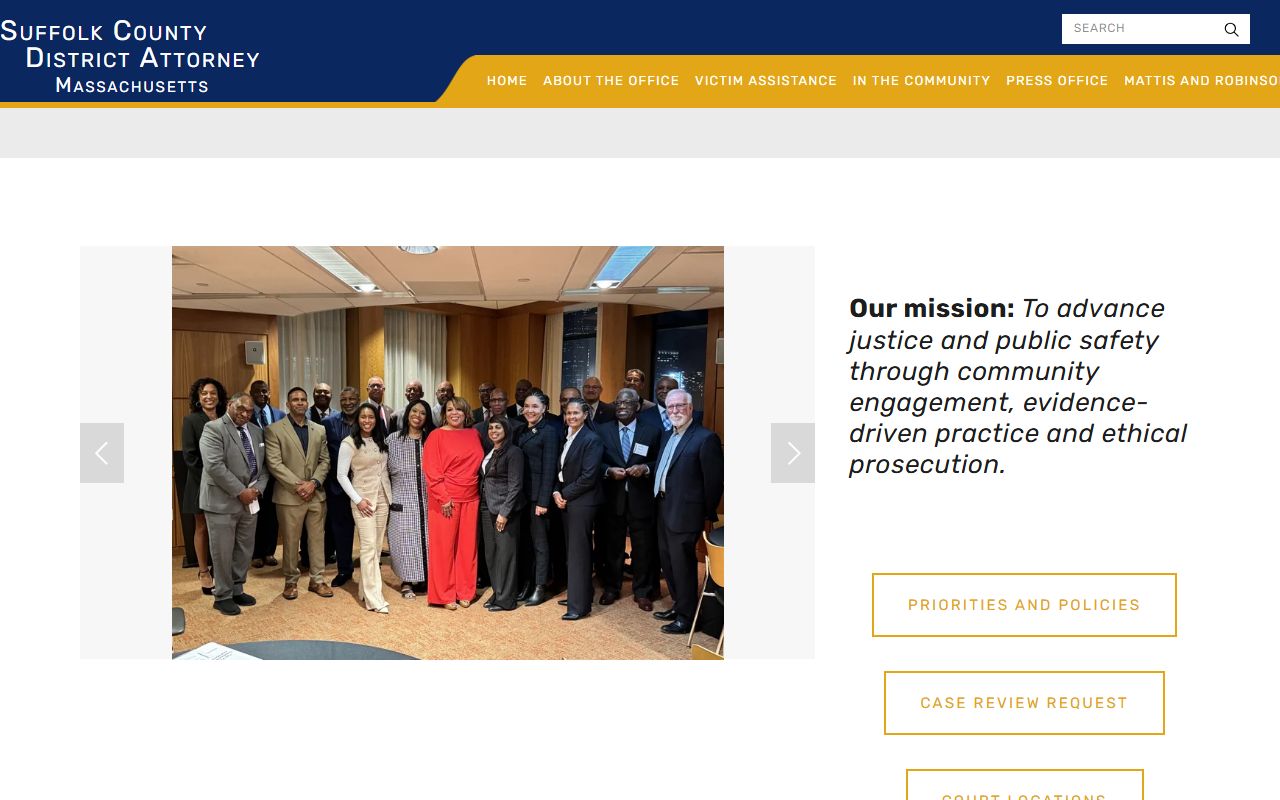
The Suffolk County District Attorney site, shown above, posts current diversion and community-justice initiatives, which change more often than statutes do.
Suffolk County Sheriff and Jail
The Suffolk County Sheriff's Department, led by Sheriff Steven W. Tompkins, runs the county's jail and house of correction. The two main facilities are the Nashua Street Jail at 200 Nashua Street and the South Bay House of Correction at 20 Bradston Street, both in Boston. Nashua Street holds mostly pretrial detainees. South Bay holds sentenced and pretrial people plus program units.
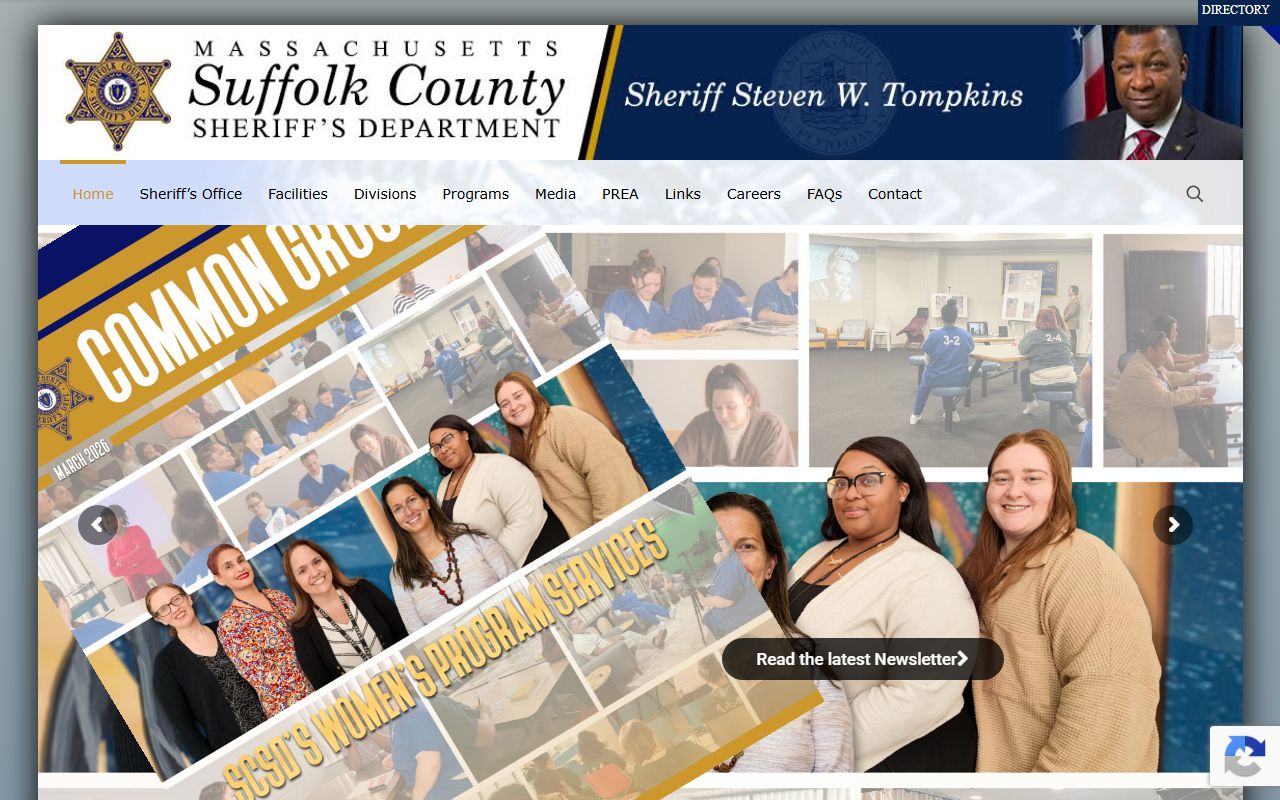
The Sheriff's Department site, pictured here, holds the official facility, visiting, and money-deposit pages. Suffolk does not publish a full live public jail roster, so custody status is checked through other tools.
For the full custody-search walkthrough, see the Suffolk County inmate records page. Check warrant records for active warrants and defaults, and released inmates for release verification.
Marriage, Divorce, and Probate Records
Family and estate records in Suffolk County route through Probate and Family Court and local clerks. Divorce is a Probate and Family Court matter. Marriage licenses come from the city or town clerk, which in Boston is the Registry Division. Estates, wills, and guardianship petitions are filed with the Suffolk Probate registry. See marriage and divorce records and probate records for the full process.
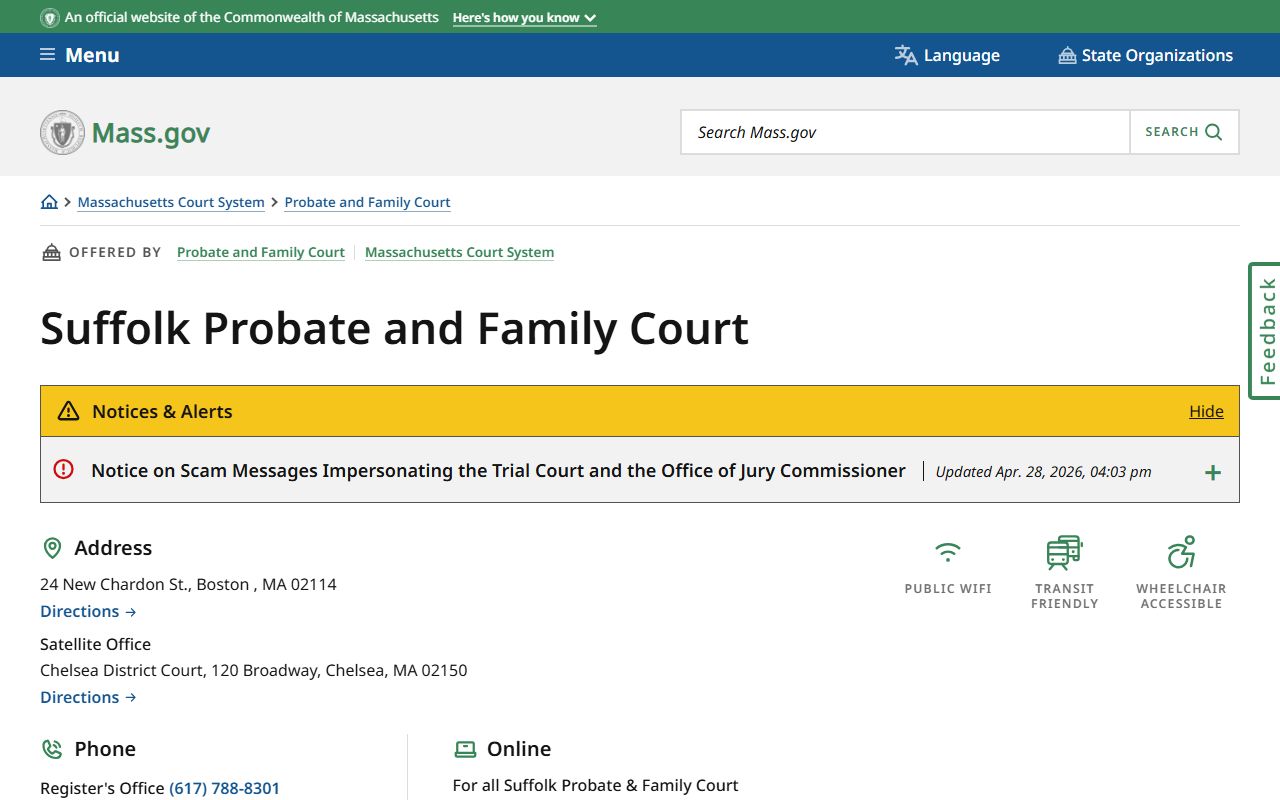
The Suffolk Probate and Family Court page above lists the Boston and Chelsea offices, hours, and contacts for these records.
- Testator
- The person who made a will.
- Executor
- The person named to carry out a will, also called a personal representative.
- Conservator
- A person appointed to manage the finances of someone who cannot.
Suffolk County Court Records Fees
Fees depend on the office and the kind of copy. Court copy and certification fees follow Trial Court fee schedules and department rules, so the safest move is to confirm the current amount with the clerk before ordering. Registry of Deeds copies, marriage certificates, and CORI reports each carry their own separate fees.
| Item | Fee Note |
|---|---|
| Court copies and certified copies | Set by Trial Court fee schedules; confirm with the clerk. |
| Registry of Deeds copies | Listed on the official Suffolk Registry fee schedule. |
| Boston marriage certificate | Order instructions and current fee posted on Boston.gov. |
| CORI report | Request fee and waiver information posted on Mass.gov. |
Fee waivers may be available for people who cannot pay. Ask the clerk about an affidavit of indigency when you file or request copies.
How to Interpret Suffolk County Court Records
Court dockets use shorthand. An "arraignment" is the first criminal appearance where charges and bail are set. A "disposition" is the outcome of a charge or case. "Dismissed with prejudice" means the matter cannot be refiled; "without prejudice" means it can. A charge is only an accusation. A conviction is a finding of guilt. The two are not the same, and a record may show charges that never became convictions.
Read the full docket before drawing a conclusion. An early entry can be reversed by a later one. If an entry is unclear, the clerk's official record controls over any online summary.
Accuracy and Record Limitations
Online court data can lag behind the paper file. Entries are added by clerk staff, and busy sessions create delays. Older Suffolk cases may sit in offline archives or under an old docket format that the portal does not show. If a record looks wrong, missing, or stale, call the clerk for the department that heard the case.
Note: Always confirm names, dates, and dispositions with the originating clerk's office before relying on an online Suffolk County record for any decision.
History of Suffolk County Courts
Suffolk County was one of the original Massachusetts counties, created in 1643. It once covered more land; today it holds Boston, Chelsea, Revere, and Winthrop. Because Boston is the state capital, Suffolk's courts have carried statewide weight for centuries. The courthouse cluster near Pemberton Square and the John Adams Courthouse, home to the Supreme Judicial Court and Appeals Court, reflects that long legal history.
The modern system grew out of the move to a unified Trial Court. Instead of independent county courts, Massachusetts now runs court departments under central administration. Record access moved from paper indexes and counter searches to MassCourts eAccess and electronic filing in many case types.
Self-Help and Legal Aid in Suffolk County
People without a lawyer have real help in Suffolk County. The Boston Court Service Center assists self-represented litigants with forms, filing, and next steps, though staff do not act as your lawyer. For criminal cases, the court can appoint counsel through the Committee for Public Counsel Services when a person qualifies.
Civil legal aid comes from Greater Boston Legal Services and the Volunteer Lawyers Project for low-income residents. The Massachusetts Legal Resource Finder screens and refers people to the right program. The Massachusetts Bar Association also runs a lawyer referral service for those who can hire private counsel.
Frequently Asked Questions
Where do I search Suffolk County court records?
Use MassCourts eAccess for public case information. Choose the correct Trial Court department and the Suffolk or Boston division. Superior Court, Probate and Family Court, BMC, District Court, Housing Court, and Land Court are separate, so a countywide name search can miss a record if you pick the wrong department.
Is there a single Suffolk County Clerk of Court?
No. Massachusetts uses clerk or register offices by court department. The Superior Court clerk handles Superior Court files. Probate and Family Court handles divorce and estates. The Registry of Deeds handles land records, and city or town clerks handle marriage records.
Can I see actual court documents online?
Sometimes docket information is online, but many pleadings, orders, and certified copies require a clerk request. Public access also depends on SJC Rule 1:24, impoundment orders, and confidentiality statutes that keep some files off the public screen.
More answers sit on the Suffolk County Court Records FAQ page.